
By Marnie Werner, Vice President, Research & Operations
Philanthropy in Minnesota is growing. In fact, the Minnesota Council on Foundations’ recent data shows that total giving surpassed $5.3 billion in 2023, with strong year-over-year increases that demonstrate the continued commitment foundations, corporations, and individual donors have to Minnesota. On the surface, this looks like a healthy and expanding system—one that should benefit communities across the state.
But a closer look tells a more complicated story. For rural communities in Greater Minnesota, the challenge isn’t about how much money exists in the system. It’s about access—who receives funding, where it flows, and whether the capacity exists locally to tap into it. If you place Minnesota’s data alongside national research on rural philanthropy, a clear pattern emerges: rural communities are consistently underrepresented in both the distribution of funding and the means of securing it.
The Reality: Growth with Uneven Reach
First, Giving in Minnesota 2025, MCF’s annual survey of their members, reports that philanthropic giving increased in Minnesota by more than 10% between 2022 and 2023 (the latest year they have data for). That’s amazing growth.
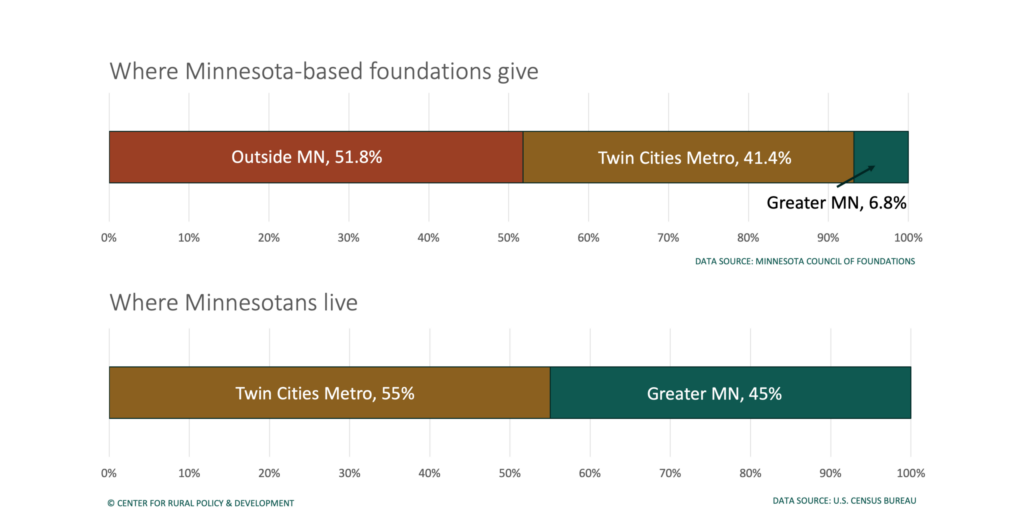
The report, however, also points out the striking imbalance in where the giving goes. Their survey found that in 2023, half of Minnesota’s philanthropic dollars went outside the state. Another 41% stayed in the Twin Cities, and the remaining 6.8% went to Greater Minnesota, despite the fact that 45% of the state’s population lives there.
This is not just a Minnesota pattern. National data from the U.S. Department of Agriculture’s Rural America’s Philanthropic Sector (March 2026) shows that grantmaking across the country is heavily concentrated in urban areas. Only about 8% of grantmaking organizations are based in rural areas, and they account for just 3% of total grant dollars given out. In addition, one-third of rural counties nationwide have no locally based philanthropic organizations at all.
In other words, rural communities are not just receiving less funding—many don’t have any philanthropic institutions that could make funding more accessible to rural areas.
Why This Matters for Rural Development
Philanthropy plays a unique role in community development. Unlike government funding or private investment, which tend to focus more on the short term, philanthropic dollars are usually more flexible. They can support early-stage ideas, pilot programs, capacity building, and long-term community planning—the kinds of investments rural communities need for sustainable growth.
But when rural areas have fewer relationships with funders, less experience navigating grant systems, and limited local means of accessing philanthropic dollars, they tend to face compounding disadvantages: fewer opportunities to apply for funding, lower success rates when they do apply; and less ability to sustain or grow funded projects.
This situation creates a cycle where communities with the greatest need often have the least access.
A Shift in Philanthropy—And an Opportunity
Despite these challenges, MCF reports that there are important shifts happening within philanthropy that could benefit rural communities. Across Minnesota, funders are increasingly:
- Providing general operating support. Over half of grants now include this flexibility. This is great for small organizations, especially ones that are just starting up, letting the grantee decide where to focus their dollars instead of the grantor telling them what to do with the funds.
- Expanding trust-based philanthropy practices. According to the Trust-Based Philanthropy Project this includes funders giving multi-year grants, but also simplifying and streamlining paperwork, soliciting and acting on feedback from the grantees, and “offering support beyond the check.” In a phrase, building partnerships instead of a hierarchical relationship.
These trends align closely with what rural communities need: flexibility, stability, and reduced administrative burden. The question now is how to connect these evolving practices to rural realities.
Strategies for Rural Minnesota Communities
To move from challenge to opportunity, rural communities will need to focus not just on attracting funding, but on strengthening their position within the philanthropic system.
Build Regional Collaboration, Not Just Local Capacity
Many rural communities are too small to compete individually for large grants. Regional partnerships—across counties, sectors, or issue areas—can create larger scale and visibility, share administrative and grant-writing capacity, and show its impact across a broader area.
Invest in Grant Capacity and Intermediaries
One of the most consistent barriers is capacity. Rural organizations often lack the staff (and the funds for staff hours) to dedicate someone to writing grants and managing complex the requirements that can come with funding.
Solutions include:
- Sharing grant-writing resources across organizations.
- Partnerships with universities or technical assistance providers.
- Regional “backbone” organizations acting as intermediaries.
Here in Greater Minnesota, we have the six Minnesota Initiative Foundations that do significant work in all three of these areas, helping move philanthropic and state money from the funders to communities in their regions.
Strengthen Relationships with Metro-Based Funders
Most philanthropic dollars are concentrated in urban areas, including “many of the grant makers focused on areas important for rural development, such as health, housing, and capacity building,” the USDA report states. That means that the rule of “out of sight, out of mind” is in play. Rural issues are not front and center for urban philanthropies like urban issues are. Because of this, there can be a lack of understanding of the unique issues rural communities face and the lack of resources they have to put toward solutions. Relationships—not just proposals—are critical.
Actively building connections beyond their immediate regions means rural communities should consider:
- Proactively engaging Twin Cities-based foundations or even national foundations.
- Inviting funders to visit and understand rural contexts.
- Framing rural projects in ways that align with statewide or national priorities.
Leverage Community Foundations and Public Charities
The USDA Rural Development report found that community foundations and public charities are more common in rural areas. We can see this reflected in MCF’s report: In 2023, 25% of community and public foundations’ giving went to Greater Minnesota compared to 6.2% from private and corporate givers.
Nationally, grantmaking public charities based in rural areas are nearly 25% larger than the average rural private foundation, the USDA report stated. “As a result, there are institutions and resources available in many rural communities that complement the larger philanthropic organizations in urban areas…,” creating the potential to build relationships and understanding around the priorities of rural regions.
Align Rural Projects with High-Funding Sectors
Those rural high-priority issues mentioned above are also the ones receiving significant philanthropic investment in Minnesota: education, human services, health, and community and economic development, applying to needs like workforce development, aging and caregiving programs, access to social services, small business support, and housing.
Rural communities can increase their competitiveness by framing their local needs within these broader funding categories while still maintaining local relevance.
Moving Forward
Minnesota’s philanthropic sector is growing and evolving. At the same time, rural communities bring unique strengths to the table that can be harnessed to ensure a good return on philanthropic investment: strong networks, local knowledge, and the ability to implement solutions on a scale that’s meaningful to the community.
For rural Minnesota, “success” means more than increasing funding. It means taking these strengths and using them to build the relationships, capacity, and strategies that make that funding accessible to all communities.
Data sourced from the Minnesota Council on Foundations’ Giving in Minnesota 2025 and the USDA Rural Development Innovation Center’s Rural America’s Philanthropic Sector (March 2026).